The joke is that we are supposed to have more free time because we are stuck indoors. But in my case — and I’m sure I’m not alone in this — taking my normal load and then adding child care and moving my classes online is not exactly what I’d call creating free time. Just. The. Opposite.
Of course, I’m very fortunate: I’ll still getting paid, and I’m shut in with other people, not unemployed and trapped alone in my studio apartment, or worse. I recognize that. But there is something tantalizing (as in Tantalus) about the current situation: More and more people in higher education and other realms are ungating more and more content during COVID-2019.
Case in point: Project Muse is ungating huge amounts of content. They’ve always been a good organization with good values who publish good stuff, so the list is long. But I’m particularly interested to see that Oklahoma University Press’s Critical Studies in the History of Anthropology series is now open access. Holy cow — that’s a lot of great work. Long-overdue biographies of groundbreaking female anthropologists like Ruth Landes and Cora Du Bois, the new (and only) biography of Franz Boas, the collected essays of Stephen O. Murray, who passed away not too long ago — the list goes on and on.
So if you have all that Copious Free Time that I wish I had, go take a gander at these and all the other great offerings at Project Muse. You’ll see the history of anthropology is far more complicated than just evil dead white men, although to be fair there are a few of those featured in the book as well! It’s a great resource that spans hundreds of years and most of the continents. Go check it out. And… thank you, Project Muse and Oklahoma!
I’ve done some refreshing of this website, adding a new background (a cc’d image of a William Morris floral textile print, iirc), updating my about page, and, most importantly…. reactivating my timeline of the history of anthropology!
I’ve been working on this timeline continuously for years now but the online version stopped working for some reason and I’d gotten lazy about uploading the source files. But now my timeline page has everything back on it again. You can view the web version online or else download the source files which you can use with Aeon Timeline, the best timeline program I’ve found to date.
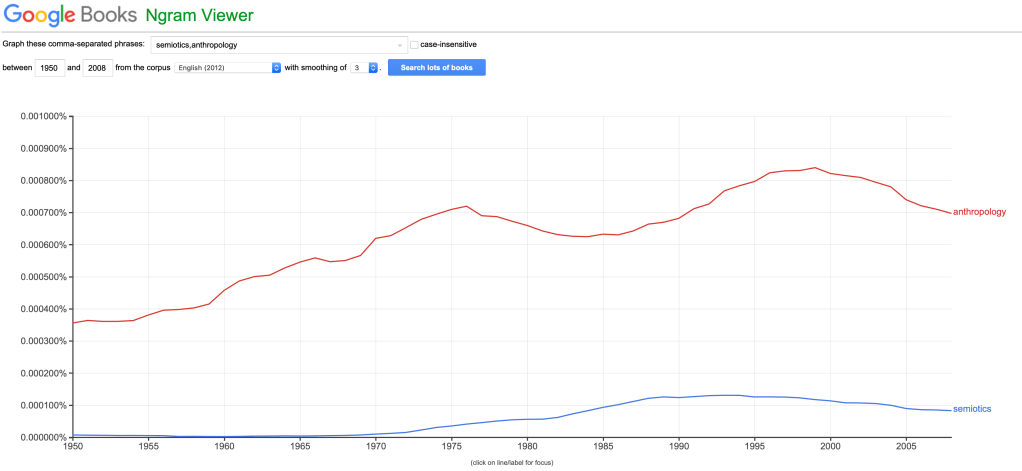
Someone in one of the my email lists was asking about the history of semiotics in anthropology, and that made me realise that I didn’t know very much about the subject, so I spent some time googling it. I got particularly interested in Milton Singer, who is interesting to me because he was hugely influential at Chicago, but afaik is basically forgotten today in my field.
A quick google seemed to confirm much of what I already suspected about semiotics: After Worlds War II many people were interested in abstraction and communication — concepts like ‘cybernetics’ and ‘information’ were in the air. As the more humanistically-inclined dug for sources they saw Saussure and Peirce as dual sources for what we now call ‘semiotics’.
In the US Thomas Sebeok was the academic entrepreneur who worked to create semiotics as a new and embracing discipline. In fact, one obituary called him the “pioneer, pathfinder, mentor, midwife, pied piper, kind Midas, gold standard, magician, troubadour, trickster,” and “friend” of semiotics. A more staid LA Time Obituary has further details and no pay wall. Linguistics as a discipline was clearly key here.
According to a short history the first major conference on semiotics was in 1966, around the same time the journal Semiotica was founded. Sebeok was involved in this and a ton of other series, often published by De Gruyter Mouton. It was a highly international affair (as many of those things were in those well-funded days) with American (and Canadian) institutional supports in people like Sebeok, as well as many European anchors. Greimas’s name appears in this literature frequently, for instance. There was also a strong Eastern European influence as well.
To me, ‘semiotics’ in anthropology means ‘Chicago anthropology, especially the work of Michael Silverstein’. Silverstein however, is just part of a larger movement. Today, this approach is well-established in other powerful departments — there is for instance Webb Keane at Michigan and Asif Agha and Benjamin Lee at Penn, Paul Kockelman at Yale, Nicholas Harkness at Harvard, and many others. So by now this tendency in anthropology has the potential to be institutionalised in most of the major departments of anthropology in North America, and seems to me to be a North American phenomenon — I can’t think of many Oxbridge types who think of themselves as doing ‘semiotics’ in this sense. Silverstein was hired by Chicago in 1971. His ground-breaking “shifters” paper was published in 1974.
But Silverstein was not the only person to discuss semiotics at Chicago. Milton Singer (useful obit here) did a philosophy degree at Chicago with Carnap in 1940 and ended up turning into a South Asianist and major force behind Chicago’s Centre for South Asian Studies, often working with Robert Redfield on projects driven by large external grants (here’s another Chicago-based obit). I am guessing war service sent him in that direction? I am sure if I read some of the sources I googled it would all be clear to me.
At any rate, in the late 1970s Singer returned to an interest in earlier questions of meaning, beginning (afaik) with the paper “For a semiotic anthropology” in Sebeok’s edited volume Sight, Sound, and Sense. Other way marks here are his 1984 Man’s Glassy Essence: Explorations in Semiotic Anthropology and 1991’s Semiotics of Cities, Selves and Cultures. While some authors have revisited this work on the whole I at least haven’t heard much about it. I do wonder about his relationship with Silverstein — the two authors were at different ends of their careers.
As a grad student in the 1990s I was assigned works such as Semiotic Mediation (1985) and Signs in Society (1994) (and the earlier papers in it) as examples of the tradition. The 2013 creation of the journal Signs in Societyseems important to me as a sign of the continued vitality of this tendency. When Paul Manning joined the editorial board of Language and Communicationin 2004 I feel like I started seeing several semiotic-style special issues appearing there.
There is more to say about all this, but I wrote this mostly to dump all my open browser tabs into my (outboard) brain, so I’ll stop here for now and let this cursory sketch stay cursory.
Honey and Poi is a history of my synagogue in Hawai‘i. I helped research it and Matt, my collaborator and friend, wrote it. In a short column for USCJ’s online magazine Journeys we talk about being Jewish in Hawai‘i and the lessons we learned about keeping our community strong and vital far from traditional American centres of Judaism on the East Coast. Check it out!
It’s been a very busy time of year for me and so I’ve done a bad job publicising my podcasts for New Books Network, and this despite my how interesting the authors and book are which I’ve been talking about! So for the record go listen to:
Both authors were great to interview. King’s book is a fresh, accessible history of Boasian anthropology which is clear-eyed about the drawbacks of the discipline but ultimately is very supportive of it. Kulick’s book is a funny, sad, personal, and not too politically correct account of his work in the Sepik and the difficulties he faced there, including some pretty harrowing violence.
That’s it for now. More soon, and I hope you enjoy these interviews!
The Cambridge Encyclopedia of Anthropology (CEA) is a peer-reviewed, open access reference work with some great topics and authors. It does a great job of making anthropology available to the public. The pieces are much longer than a normal encyclopaedia article, they are signed, and they have citations — my piece is basically a condensed literature review. The accessibility of the entries varies widely. Some are really good for the general reader, while others are more specialised. But over all I think the project is very useful and I’m glad I contributed to it.
There are a lot of long, more in-depth reviews of the anthropology of mining out there. I think especially of the reviews by Godoy, Ballard and Banks, and Jacka in Annual Review of Anthropology. But if you don’t have access to that serial, or if you just want something shorter, I hope you’ll take a look at my piece. It was a mind-expanding, exhausting experience trying to synthesise al the literature I had to read for it. In particular, I learned that I will never be able to keep up with the massive streams of work on ASM (artisanal and small-scale mining) issuing forth out of Europe. But it was still a fun challenge to do my best. If you think I totally mischaracterised your work or anyone else’s… let me know. And if I didn’t then hey… maybe this piece will be valuable in the long run to people new to anthropology and mining!
I love ebook sales. They’re a great way to pick up books you’ve always wanted but couldn’t afford. In fact, they’re a great, low-cost way to take a chance on book you’ve never heard of but which looks interesting. Heck, there’s an education to be had just scrolling through the books on sale and discovering new authors. For people without access to an academic library (or who have run out of room in their home libraries *cough*), cheap ebooks are a great way to get more access to knowledge. Radical publishers like Verso, Pluto, PM Press, and others have long had ebook sales (thank you!) and now The University of Chicago has thrown their hat into the ring with a 75% off sale. What are the best ways to approach this sale? Read on!
Think before you buy. Then browse like crazy
Chicago let’s you download spreadsheets of their lists (a ‘list’ is publishing speak for ‘all the books we publish in a certain area’. There are ‘history lists’ and ‘philosophy lists’ etc.). So: Sit there and think about what topics you are interested in and what authors you have to follow. Then download the spreadsheet and look through their list trying to find books that match your interests.
It’s only about 370 entries, so it won’t take too long to scan. And again, just scanning the list is an education in and of itself.
Then once that is done and you have a sense of what you want, feel free to go crazy and explore Chicago’s website. Browse random-ass topics that sound interesting but that you know nothing about. Who knows what treasures you might find?
One important thing to note about the Chicago website: The “Only General Interest Books” button. Toggle this bad boy to see what the press thinks are their most appealing books. If you are an anthropologist like me, for instance, and want to learn about physics but know nothing about it, this is the way to find non-opaque physics books.
Buy at both ends of the price curve.
The first thing to note is that this is only a 75% off sale, and not a 90% off sale, like Verso’s. And alas, Chicago’s ebook prices are higher than Verso’s as well. This sale is not about buying a US$15 ebook for 90% off. It is about a bunch of ebooks at US$35 for 75% off.
To me, US$5 is the maximum I’d pay for an ebook ‘on sale’. After all, these days its not unusual for academic titles to go for US$10 to US$20 (which is what the print price tends to be). Paying more than 5 bucks doesn’t feel like a deal to me. It feels like the real price of an ebook, and the list price of US$35 feels too high. 2 bucks is the price point at which I start buying stuff just because I might read it someday. I don’t change my behaviour for any price underneath that. To me paying 1 buck for an ebook is basically like paying 2. But I’m a rich first worlder, so ymmv.
Overall, I think it makes more sense to buy at both ends of the price curve: find expensive books you really want and can’t get elsewhere, but then also snap up some cheapies (I highly recommend the Chicago Guides to the Academic Life and Writing, Editing, and Publishing) that are a steal at 75% off. Go big for a big discount, or go small for a small final price — the books priced in the middle are kinda just an ok deal at 75% off.
Make sure the book you want isn’t available elsewhere
If you are a student or professor, make sure your library doesn’t already have the title you’re looking for as an ebook. Chicago is not a speciality press — lots of libraries carry their titles. If you haven’t already, get a public library card. your local public library probably has a pretty good selection of ebooks, including academic ones.
You should also check Google and Amazon, the two main vendors of ebooks. Chicago books are cheaper on Google than they are on Amazon, so check Google Books or Google Play. Depending on how Google marks down its ebooks, and how Chicago marks them up, I think there are a few cases where it is actually cheaper to buy the book on Google than it is to buy it from Chicago, even at reduced price. Or the difference is negligible.
Google Apprentice Alf
Chicago’s ebooks come with DRM, or digital rights management. This makes them difficult to read and annotate on your preferred ebook reader. It also makes it difficult to share the book for teaching. Afaik, it is ok to share 10% of a book, or 1 chapter, with your class (this is called ‘fair use’). But DRM makes this a pain in the butt to actually do. I’d recommend using a tool like Apprentice Alf to free your ebooks of DRM so you can read and annotate them as you like.
That said, this post is about how to give the press your money. Chicago is huge by university press standards, but it’s not Elsevier — it’s not unreasonable to ask you to actually buy recent in-print books from them instead of downloading them from some Russian library site, especially if you are relatively well off by global standards. DRM removal tools about making your books easier to use, not easier to circulate. Which brings me to…
And finally… don’t forget to read your new books!
Learning is different from downloading. No matter how many PDFs or ebooks you download, you will not learn much from them until you actually read them. I know, I know, sometimes it feels if you download enough of them, and very quickly, somehow the experience is educative. But really, we all know better than that. The best thing to do with your books is read them. So turn off your social media feed, force quit your email, deactivate the alerts on Bubble Witch Saga 2 on your phone, and enjoy the fruits of all your sorting, browsing, and clicking by actually reading the books you’ve purchased. The people at Chicago are a weird lot — I know, I’ve met them! — they aren’t driven by avarice. They genuinely are more interested in having their books read than they are in filling a bathtub full of gold doubloons and jumping in. Make them happy and read their authors.
What books would you recommend from the sale? Any advice I’ve overlooked? Reach out to me on Twitter and let me know!
My new episode of New Books in Anthropology is up — it’s an interview with Christina Thompson on her book The Sea People: The Puzzle of Polynesia. It’s a history of European attempts to understand the prehistory of Polynesian and Austronesian migration. It’s a very well written and well-structured story that starts with the Spanish discovery of the Marquesas, goes through Kon Tiki and Hokule‘a, and ends with contemporary work. I was impressed by the amount of work that it covers, and how easily it goes down, and it was blurbed by Pat Kirch at Matt Matsuda so you know most of the details were right. I think this will be a go-to book for people who want to get started understanding the prehistory of the Pacific.
At the same time, I can imagine that some of my colleagues would take fault with the decision to write a book about white people studying the Pacific rather than just focusing on Pacific Islanders themselves. Christina has defended this choice — which I feel is a legitimate one — and notes that she covers people such as Nainoa Thompson and Te Rangi Hiroa. But I still felt this book read very much as a story of a Western project of knowing into which Pacific Islanders were eventually incorporated. I don’t know — maybe this reflects my own concern about how we conceptualise and tell anthropology’s history. Another shortcoming is the inevitable ‘what got left out’ question: While historical linguistics is mentioned, that story doesn’t get told in the detail it could. But of course it’s inevitable that a book tells some stories and not all others (at least, this is a problem all non-infinitely long books have).
My favourite aspect of this book is that it turned me on to the work of the wonderfully-named Willowdean Chatterson Handy. Christina’s section on her inspired me to read Handy’s Forever The Land Of Men, her memoir of doing fieldwork in the Marquesas in the 1920s alongside her husband and Ralph Linton. It is a hidden gem of a book and if you can find a copy I’d highly recommend it. I was particularly interested to see how thoughtful Handy was about the impact of colonialism in the Marquesas and her own positionally as a researcher. Inspired, I asked a friend of mine who studies the Marquesas what he thought of Willowdean.
“She was smarter than [her husband] Handy,” he said to me.
“How can you tell?” I asked.
“Everything the co-wrote is better than his solo publications!” He replied.
In sum, I recommend Christina’s book very warmly although I recognise it might not be framed in a way that will please everyone. I hope you enjoy listening to our conversation!


 Alex Golub
You must be logged in to post a comment.